Every writing assignment must be original. Grammar checks should not be used.
Students are encouraged to use artificial intelligence tools to brainstorm, but written work must be original.
Spellchecks and citation generators are permissible, but AI cannot be used for research or writing.
These are a few of Bethel University professors’ policies on AI use in student writing. As junior Lily Noonan examined her courses’ syllabi, she noticed that some professors encourage the use of the technology, while others have restricted students from utilizing AI in its entirety.
“I’ve had some amazing professors who have taught me how to use AI effectively, but I’ve also had professors who strongly discourage its use,” Noonan said. “Because Bethel professors have such different perspectives, it can be difficult as a student to know when it is appropriate to use AI and to separate my own views from the expectations of each class.”
Since the fall semester, Bethel has piloted a voluntary program for professors to use Grammarly Authorship in their classes. With this tool, professors can view the author’s writing process for an assignment after it is submitted. The platform identifies and categorizes which writing is manually written, copied sources and AI-generated in the document.
The Grammarly Authorship pilot program is currently being utilized by several communications and business professors at Bethel. Professors who volunteer for the program request that students enable the feature on their computers whenever they are working on assignments.
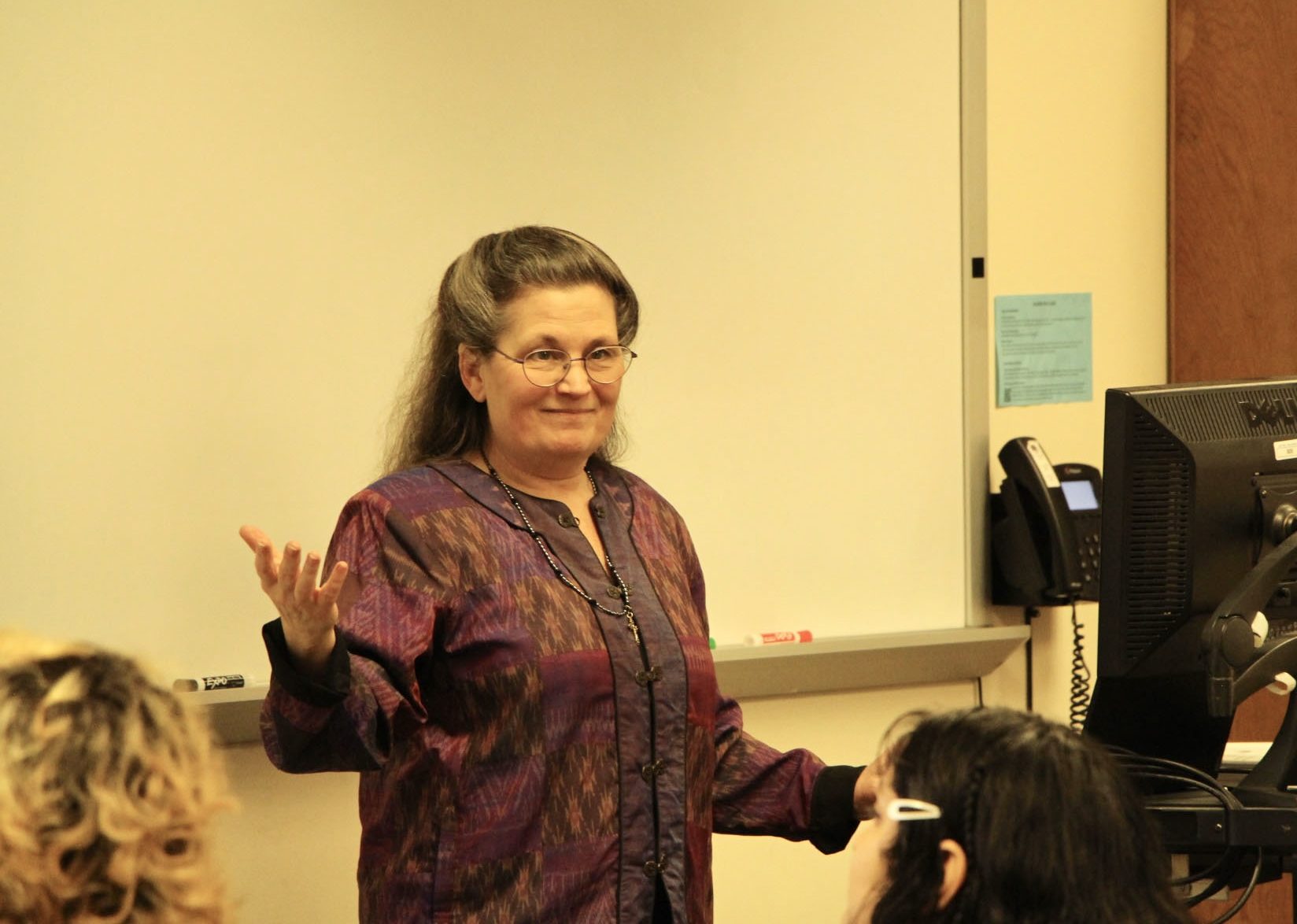
Associate Professor of Political Science Lynn Uzzell volunteered to participate in the Grammarly Authorship program in the fall. Uzzell said that in the classroom, AI has become harder to detect in academic writing and assignments than traditional plagiarism.
“[Detecting AI is] tremendously time-consuming, and it’s demoralizing,” Uzzell said.
The use of AI in academic writing has become increasingly popular across schools. According to the Pew Research Center, over half of American teens use an AI chatbot to help complete their schoolwork.
“What I’ve seen in the last two years has been more cheating cases than all of the years in the classroom before that,” Uzzell said.
Grammarly Authorship tracks down AI-generated or plagiarized writing more efficiently to help professors combat cheating. It also allows students to understand the stakes of using AI. Rather than hoping to catch more students using AI, Uzzell said she hopes to find fewer cases due to the increased detection.
“One of the benefits is that the student knows that there’s accountability,” Uzzell said. “I don’t want to catch cheating.”
The online program also allows students to prove they did not use AI if they are suspected, rather than punishing people without evidence. Despite this aspect, the implementation of Grammarly Authorship can create pressure on students, causing them to worry about being constantly monitored. Noonan commented on finding a balance between the two concerns.
“I think [Grammarly Authorship] is most effective when used as a tool for transparency and learning rather than only for enforcement,” Noonan said.
Some Bethel courses, such as business classes, encourage the use of AI, as it provides helpful technological tools and suggestions. Students use the technology to generate outlines, bring clarity to academic directions or brainstorm ideas.
“In my experience, AI has been most useful as a support tool,” Noonan said. “I use it to organize my thoughts and better understand assignments or concepts.”
Assistant Professor in English and Journalism Scott Dill pointed out the fine line between students using technology to their advantage and becoming reliant on it. While Dill does not use the Grammarly tool in his classes, he previously conducted a classroom experiment where he allowed students to use AI however they pleased on a writing assignment. He found that AI tools helped students with grammar and comprehension. However, it also produced untrue facts about books and articles and has a formulaic thinking pattern. With this in mind, he highlighted the importance of maintaining a healthy balance with the tool so that it does not become a crutch.
“I don’t think AI is itself damaging,” Dill said. “It’s the habits we form around the thing.”
Dill said he hopes that, rather than turning to tools to solve our problems, students will turn to one another.
“No thinking is ever going to be efficient,” Dill said. “It’s something that you have to learn how to do. But you learn it from people.”
Because AI can communicate using human-like dialogue, users can be tempted to turn to the technology for connection or advice. According to a Pew Research Center survey, 16% of teens say they’ve used AI chatbots in casual conversations, and 12% say they’ve asked these chatbots for emotional support and advice.
“I also worry that we’re going to become a society in which nobody’s actually communicating with each other,” Uzzell said.
Some professors’ concerns about AI extend beyond cheating in academic essays and consider how we interact with one another as a “community of human beings,” as Dill said.
Dill pointed out the irony of using some of these devices — for example, Grammarly Authorship uses AI to discourage students from using AI in writing. Quoting Henry David Thoreau’s 1854 novel “Walden,” he asked if we are becoming “the tools of our tools.”
No matter one’s opinions on how useful or harmful Artificial Intelligence is in everyday life, the technology has become a worldwide phenomenon. However, it is up to the user how to utilize the tool.
“AI is not going away, so I think it is important to learn how to use it properly and professionally,” Noonan said.