
University of St. Thomas sophomore Drew Fernelius played the number one singles match against Wheaton College in April 1991. Fernelius’s opponent, nationally ranked, took him to the third set, which Fernelius won 7-5. The win also secured a 5-4 team victory for the Tommies over the nationally ranked Thunder.
Following the team’s loss, Wheaton players surrounded Fernelius’s opponent, comforting and supporting him. Meanwhile, Fernelius, the victor, stood on his home court watching. Alone.
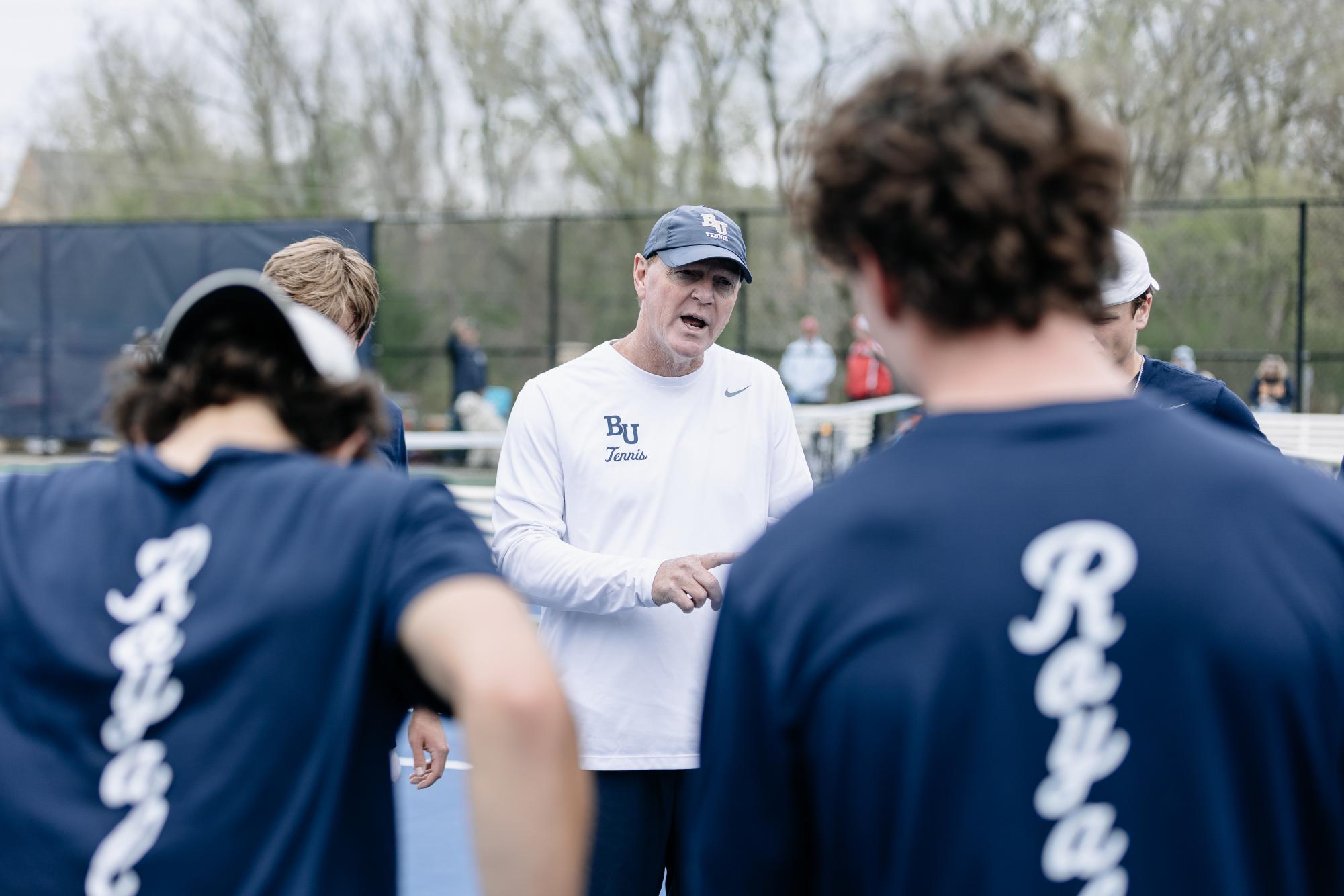
Thirty–five years later, Fernelius, a 2019 St. Thomas Hall of Fame inductee, serves as head coach of both the men’s and women’s Bethel University tennis teams. His mission is to provide the same atmosphere he saw in Wheaton’s team.
“Now, as a leader of a team, I want that,” Fernelius said. “And I want players that want that.”
‘I’m not just playing for myself’
Fernelius paces the courts of Bethel’s Ona Orth Athletic Complex April 25, keeping an eye on his men’s doubles teams.
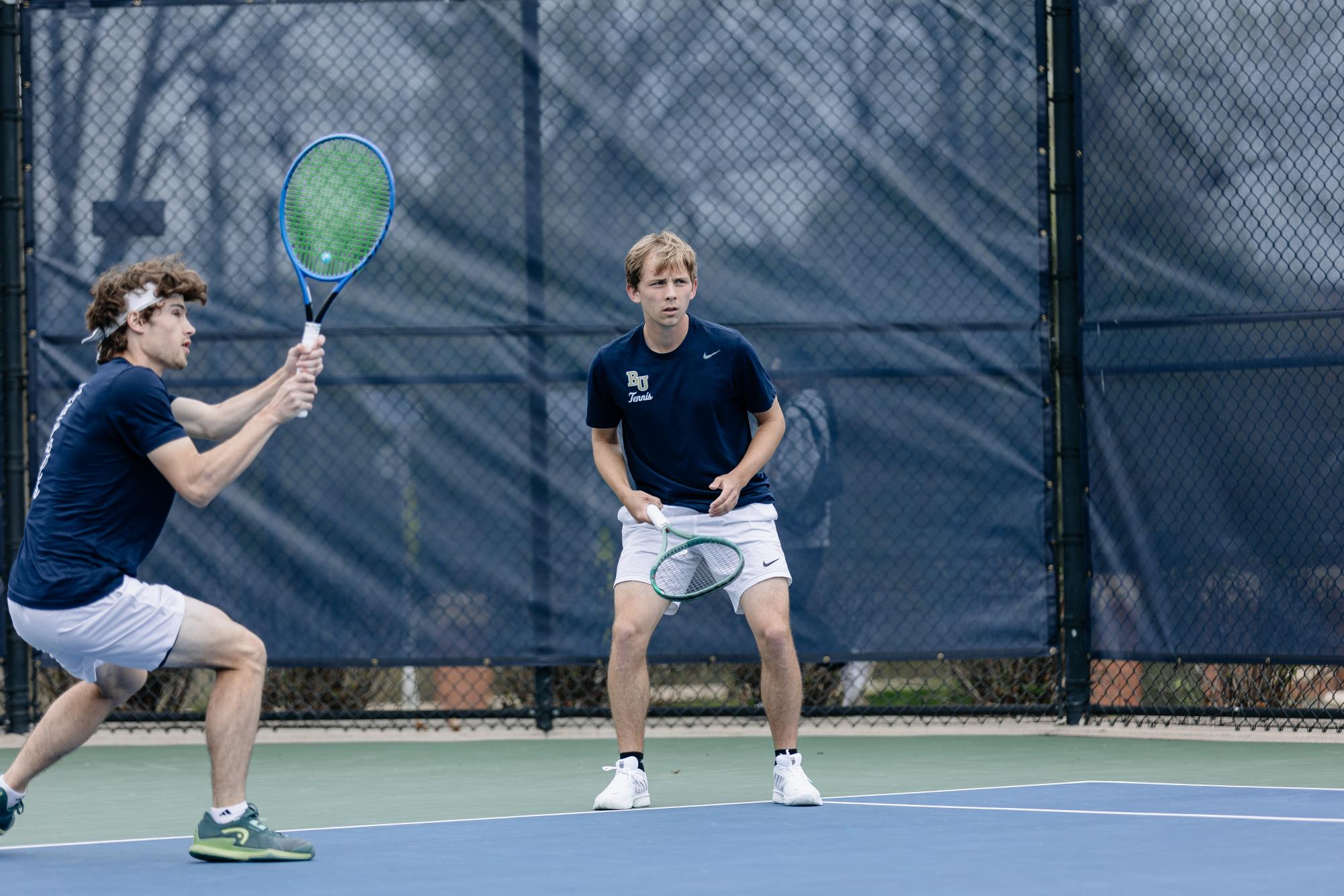
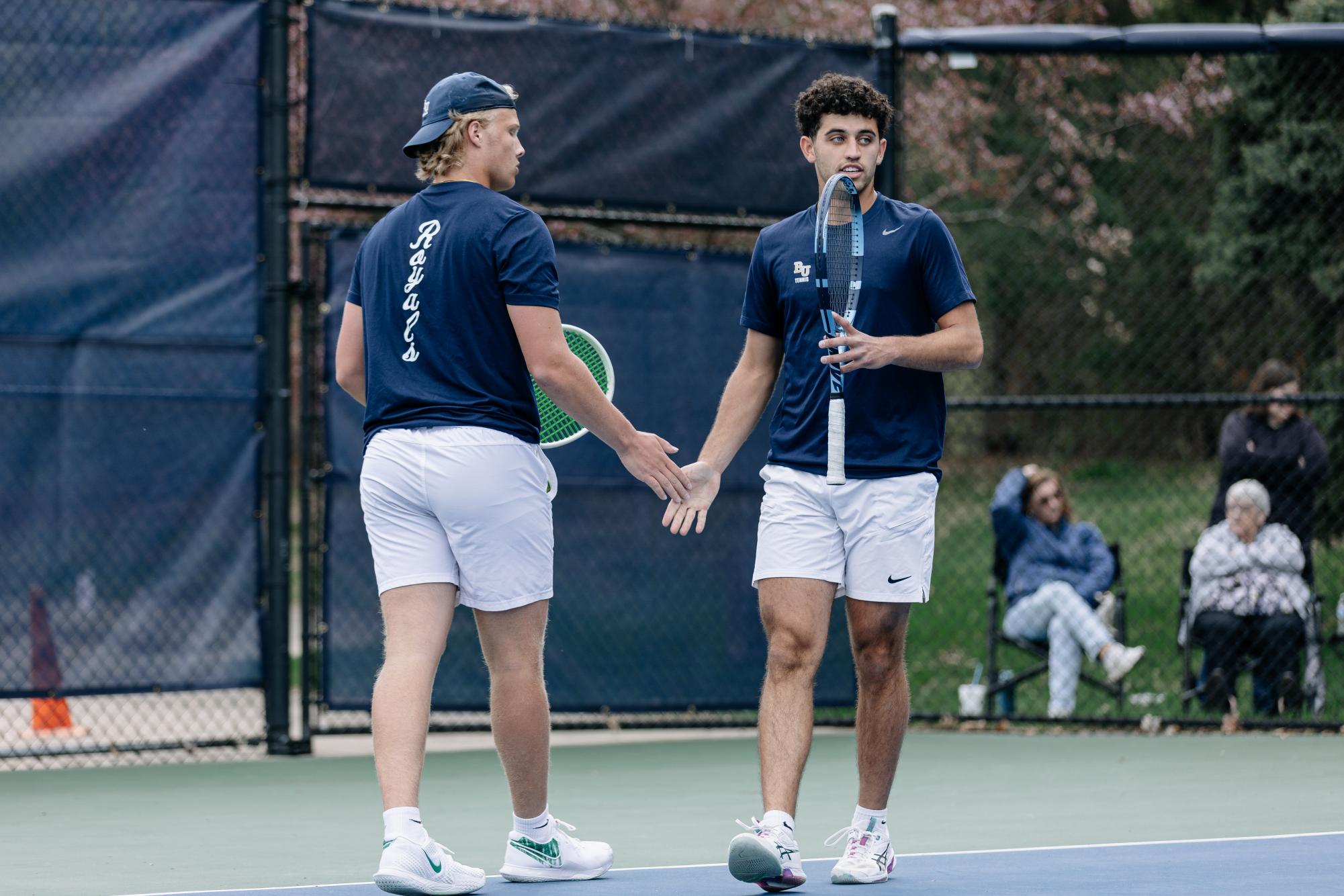
Carter Sheard whacks a forehand across the net. Dylan Magistad returns a serve. Ethan Ahrar high-fives Eli Scheideman. Across four nets, the pop of tennis balls flying back and forth rings out, occasionally interrupted by the team’s liturgy. Anyone can begin it, but once they say, “Let’s go, Royals!” players echo it one by one.
Between sets, Magistad, a senior and captain on the men’s team, uses two hands to take a sip from his massive blue cooler jug. He’s hardly swallowed before he looks across the courts and begins calling out his teammates by name.
“C’mon, Beng! C’mon, Micah!” Magistad shouts at partners Zach Bengston and Micah Gustafson.
A few seconds later, “Beng” calls back.
“Here we go, Dyl. Let’s go, Carter.”
With Fernelius as head coach of both the men’s and women’s teams, the Royals have a unique crossover in team dynamics. The bond between the two teams often starts on their combined spring break trip, typically in March.
This season’s trip to Florida included six matches in five days for the men and five matches in four days for the women. Collectively, their record was 11-0.
Outside of tennis, team bonding is the primary focus for Fernelius’s players. After sets of beach volleyball, playing in the pool and three-hour kitchen chats, women and men get together for “devos” – chances for each player to answer several pre-determined questions regarding his or her faith. Players foster camaraderie for one another as they learn more about each other on a deeper level.
“When you know the person to your right and to your left cares about you,” Fernelius said. “I’m not just playing for myself, I’m playing for that person and that person and the whole team.”
The team carries its connection on the plane back to Bethel amid the quick transition into spring conference play. The men’s team plays Among Us on the van rides to matches. The women’s team shops together. Everyone knows there’s more to their life and relationships than just tennis.
‘Stupid smiles’
The balance between retaining a competitive edge and loving teammates is a delicate one, especially in a sport based almost entirely on rankings. On any given match day, Fernelius selects six singles players and three doubles teams to compete in the lineup. The results of their matches determine the overall outcome of the team’s match.
Whichever team wins two (or all three) of the doubles matches wins one point, and the other six points are determined by each singles match outcome.
Yet, the women’s roster houses 11 players this season, and the men’s has 13. Not everyone gets to directly contribute on a given match day. Most of the rest of the team participates in exhibition doubles matches.
Magistad still sees the players out of the lineup as key contributors to the team’s success.
“They’re cheering on the whole time,” Magistad said. “That’s super big mentally for those of us that are playing, because you feel more uplifted and you know that people are there for you.”
The cheering crosses over from team to team, too. Since both teams share the same head coach, neither typically play at the same time as the other, leaving opportunities for the “rambunctious” men’s team, as Fernelius described it, to support the women’s team, and vice versa.
But this doesn’t make any of Fernelius’s players soft.
“Don’t get me wrong. There’s competitiveness,” Fernelius said. “Our guys want to play the highest. The women want to play the highest they can. But that’s not where your value comes from.”
Ethan Ahrar, a senior on the men’s team, knows this. In his four years playing for the Royals, he’s competed in eight matches in the lineup. Throughout the years, Ahrar has seen many of his teammates, some younger than him, leap ahead of him in the team’s rankings, while he’s left competing in exhibition doubles matches that don’t count for the team score.
It used to drag him down.
“I started to realize if I had a bad day at practice, it would really make the whole rest of the day, by accident, kind of be down in the dump,” Ahrar said.
With this realization, Ahrar flipped his mindset to help the team in less tangible ways. He’s now dedicated to bringing “stupid smiles” to his teammates, especially in such a high-pressure sport.
Ahrar’s teammates nicknamed him Monk, short for monkey, in honor of his goofiness. During the team’s annual mixed doubles tournament during spring break, Ahrar donned an oversized, fuzzy, bright blue Cookie Monster hoodie – a nod to another one of his nicknames from his freshman year: Cookie Monster.
“The team has poured so much into me that I just have to do my best to pour into them too,” Ahrar said.
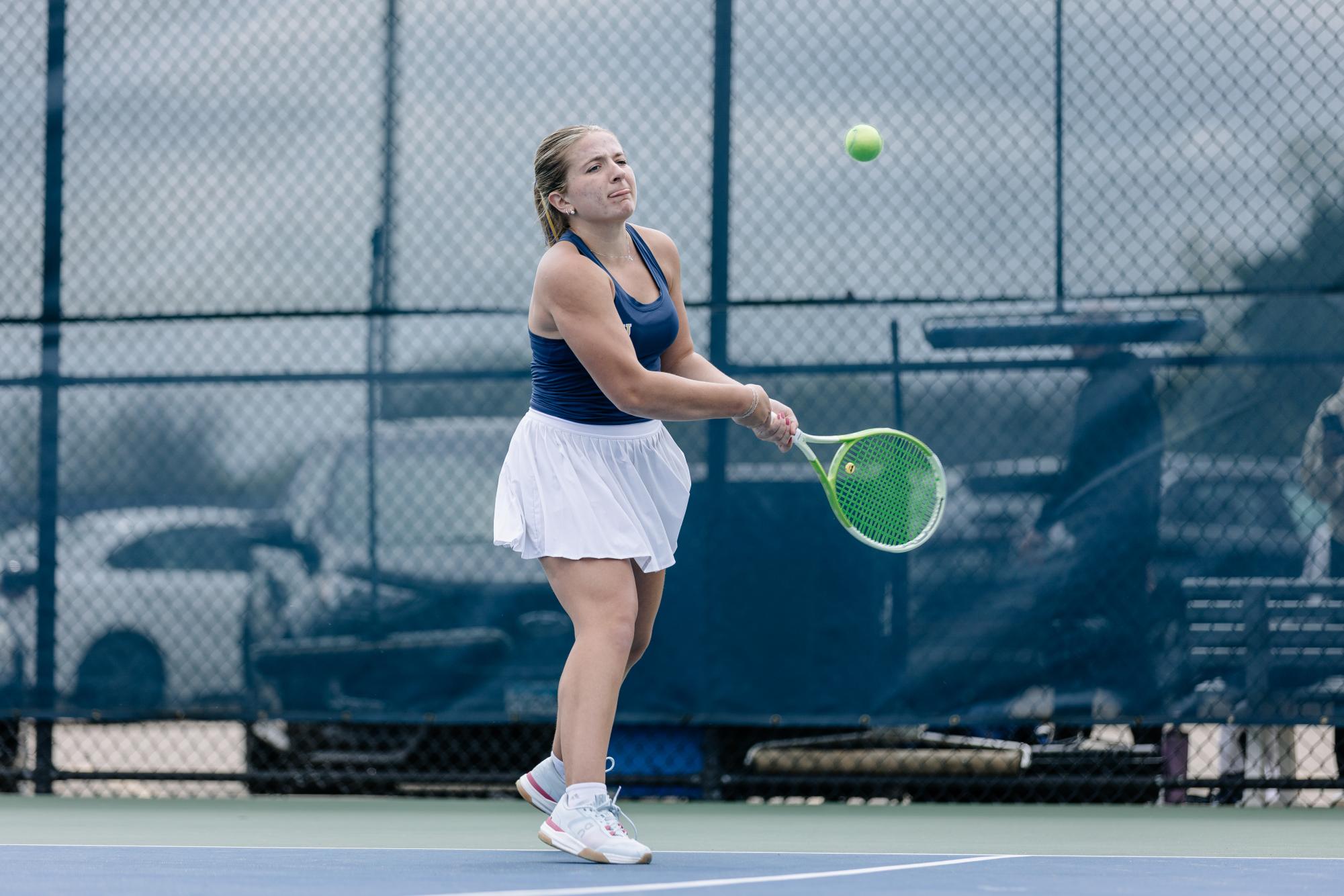
Women’s team freshman Addie Carlson recognizes similar ways to contribute. She usually finds herself outside of the lineup, but it doesn’t stop her from competing as hard as she can. She still wants the respect of her teammates.
“The more I just exert leadership, the more respect I gain from my team,” Carlson said, “It’s crucial to the way we play and interact with each other and trust each other.”
Her leadership example comes her team captains: junior Michaella Sullivan and senior Lauryn Douglas.
“They’re very fierce competitors,” Carlson said. “You just look at them and look at their game, and you have respect.”
‘Everyone wants to win very bad’
While building a team culture with a foundation of love for teammates, Fernelius has achieved significant success in his 14 years leading the Royals.
Fernelius owns a winning record on both the women’s and men’s teams. He’s won the Minnesota Intercollegiate Athletic Conference (MIAC) Coach of the Year award three times as the women’s coach and has a combined 16 MIAC playoff appearances with both teams.
“He’s the most competitive person that I know,” Sullivan said.
That competitiveness rubs off on his players. When Sullivan and her doubles partner Douglas made it their goal to reach the Intercollegiate Tennis Association (ITA) national tournament, they spent their last two summers hitting with each other every morning at 6 a.m.
It paid off when the duo beat Gustavus Adolphus College’s number three and number two doubles teams in the regional tournament to qualify for the national tournament. From there, their goal was to win a match, and they did just that, making them the first Bethel team to win an ITA national tournament match.
This season, as of April 25, Bethel’s women’s team has been ranked in the top 30 of the ITA since April 1. Douglas didn’t lose a regular-season singles match.
But for Bethel tennis, individual success is hardly the most important element.
When the men’s team beat St. Scholastica 4-3 April 11, Magistad’s doubles and singles matches were both losses. And yet:
“He said he was probably more happy than I’d ever seen him,” Fernelius said.
Once at a team lift, Sullivan asked Danny Kulus, the team’s lifting coach at the time, if he could tell based on the effort of each player who was in the lineup and who was out. He couldn’t. Carlson was no exception.
“She’s a freshman and she’s not in the lineup,” Sullivan said. “But you would never tell [because] of her work ethic and the way that she carries herself on the court.”
The women’s team finished its regular season 18-2 overall, 7-2 in conference, while the men’s team completed its regular season with an 18-3 overall record and 6-3 in conference. Both teams move to the MIAC playoff semifinals April 30.
In the MIAC playoff quarterfinals, the Bethel women beat Hamline University 4-0, moving on to play at Carleton College April 30. The men exacted revenge following a regular season loss at St. Olaf College, winning their playoff matchup 4-1 April 29. They play at Gustavus Adolphus College May 1.
Both teams lost their semifinal matchups, but Sullivan and Douglas won their doubles match and Douglas won her singles match, ending her season undefeated.
Sullivan and Douglas qualified for the 2026 NCAA Division III national championship, which begins May 22, in Tennessee.
They’ll continue playing for each other, as Fernelius encourages the entire team to do.
“Love what you do, you’ll never work a day in your life,” Magistad said. “That’s Coach [Fernelius] for sure. That guy doesn’t work a day in his life, except piling together all the receipts from spring break.”