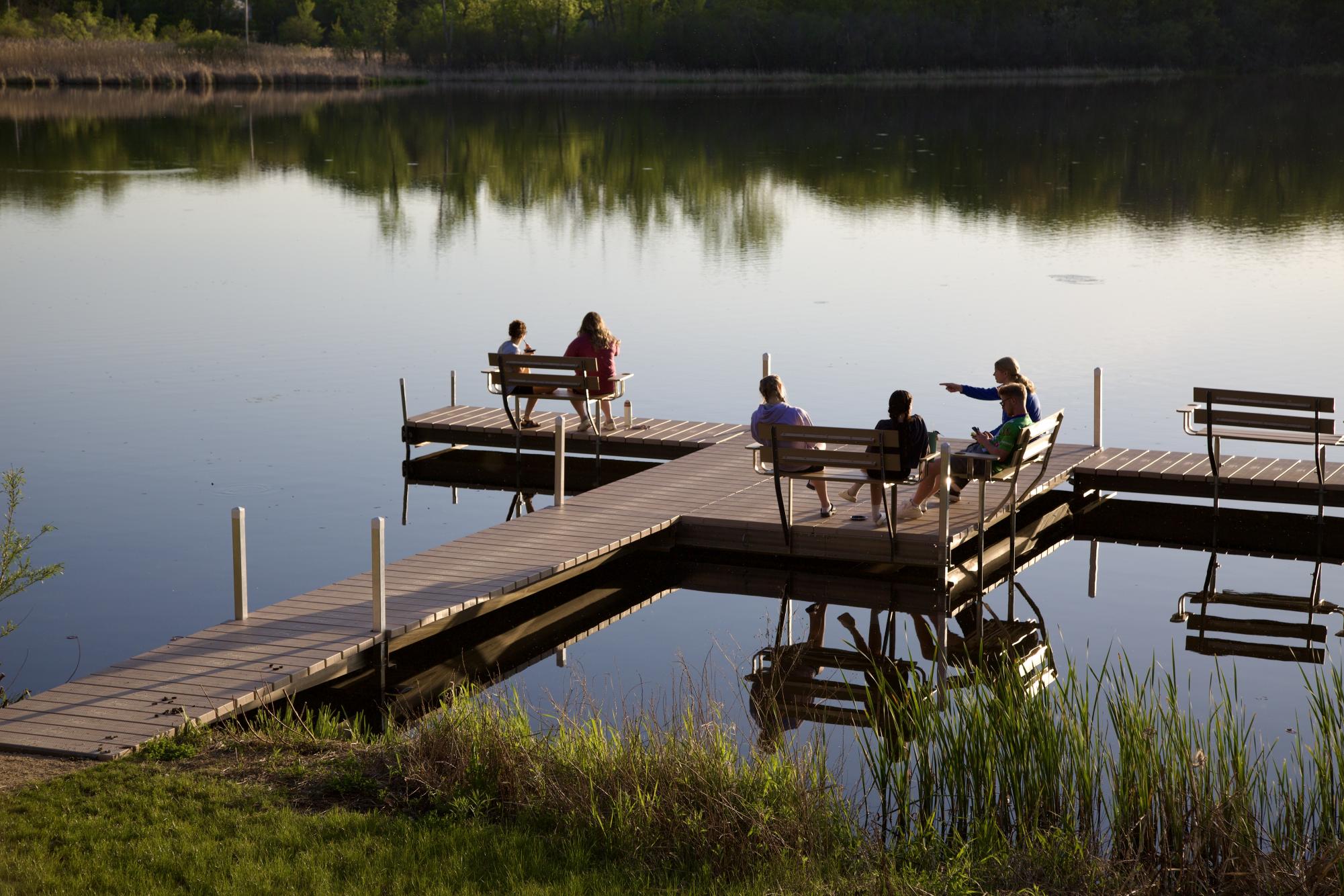

Caleb Meeker felt spontaneous. It was finals week of the Spring 2023 semester, and with the extra time from Wednesday’s study day, Meeker was on the lookout for something exciting to do. His idea of a good time? Grabbing some friends and swimming across Lake Valentine.
“A couple of my roommates and I had done longer swims [in] other lakes before and thought it would be fun to do it at Lake Valentine,” Meeker said.
On the other hand, Meeker’s friend Joe Franzen chose to show his support from afar. After dropping his friends off on Old U.S. 10, he waited with towels as the group swam back to the docks. Franzen never joined them in the water, which he described as “almost rancid.”
“Just from looks and honestly smell too, the lake always seemed full of bacteria and things I didn’t want to be in contact with,” Franzen said.
Franzen wasn’t alone in this.
The rumor that the lake isn’t safe to swim in has circulated the student body for decades, according to Jeff Port, an environmental studies professor within the biology department, who has been teaching at Bethel since 2001.
The algal blooms in late spring and throughout the summer give the lake a rather unappealing appearance, but according to Corbin Sams, one of Port’s students, that doesn’t necessarily mean Lake Valentine is unhealthy.
Dr. Port, who taught Ecology during the Fall 2025 semester, also emphasized the importance of distinguishing student rumor from reality.
“Overall, the water quality in Lake Valentine has improved over the last 30 years, in large part because of decisions that were made here on campus,” he said.
Those decisions were the work of Bob Kistler, professor of Biological Sciences emeritus.
Water quality over the years
In the 1980s, lawn management around Lake Valentine looked vastly different than it does today. Mowing and fertilization along the shorelines created a clearer view of the lake. However, the chemicals in the fertilizer—primarily nitrates and phosphates—continually contaminated the waters and led to massive algal blooms every summer. By the time spring rolled around, the banks of Lake Valentine were riddled with dead fish.
“You’d have this slimy green lake in the summer, and then next spring, you’d have a bunch of rotting, smelly, dead fish on the shore,” Port said.
Kistler made it his mission to change this, and in the 1990s, he proposed and implemented a conservation initiative. A variety of trees, shrubs and other vegetation were planted along the shores and allowed to grow naturally. Bethel’s landscape management has since shifted its maintenance away from the waterfront.
That very same lining of plant growth that Kistler advocated for can be seen along the Russell W. Johnson Nature Trail today. It’s a natural buffer that prevents the flow of chemicals into the lake, and according to Port, it’s made all the difference in preserving the health of Lake Valentine.
“The buffer zone, that vegetation zone around the lake, is actually really, really important in terms of helping to maintain the health of the lake,” Port said.
Findings from ecology students
Following in the footsteps of Kistler’s work, Port’s students ran tests for water quality and explored Valentine’s ecosystem as part of the ecology curriculum this past fall.
For juniors Anders Hagfors and Gavin Shady and seniors Ava Randecker and Anna Tikkanen, this meant studying the macroinvertebrates inhabiting the waters. The group ran Ephemeroptera, Plecoptera and Trichoptera (EPT) tests, which determine water quality based on the presence of specific insect species within the lake.
The group primarily found the larvae of three bioindicators—damselfly, dragonfly and caddisfly—but also discovered some leeches towards the lake’s northern end.
According to Hagfors, this is typical for lakes of this kind.
“It’s best to assume that if you swim in any lake in Minnesota, you pose the risk of being exposed to leeches or swimmer’s itch,” he said. “Both of those aren’t especially harmful, but may be a deterrent to some who would want to swim.”
Other Ecology students, such as junior Corbin Sams and his research group, also found that the water quality data aligned closely with other Minnesotan lakes.
“Lake Valentine is a quality lake for the circumstances it finds itself surrounded by,” Sams said.
The lake supports a strong diversity of wildlife, indicating an overall healthy ecosystem. Apart from waterfowl, muskrats and beavers, numerous fish species also call the lake home. Sams, who fishes regularly, has caught many different fish, from Largemouth Bass and Northern Pike to various species of bullhead and carp.
The real risks
Although Lake Valentine’s ecosystem is generally healthy, some risks still exist.
The lake’s high vegetation, shallower depths and smaller size make it more susceptible to warming in the summer. While these characteristics make the lake home to many animals, that also means it supports ideal conditions for the parasites that accompany such wildlife.
In particular, one of the largest concerns for Lake Valentine’s swimmers is swimmer’s itch. This, along with the potential for bacterial—especially E. Coli—infections, is a reason to be conscious about swimming in the lake.
Another finding from Port’s ecology students was the presence of microplastics in the gills of fish caught for research. The source of these microplastics and the effect they have on humans remains speculative, but they are present in the lake.
One of the largest threats to Lake Valentine’s overall health is salt runoff from nearby roads such as Interstate 694 and Snelling Avenue. The chemicals contaminate the water during snowmelt and contribute to the yearly algal blooms. Additionally, these chemicals aren’t safe for the human body to ingest.
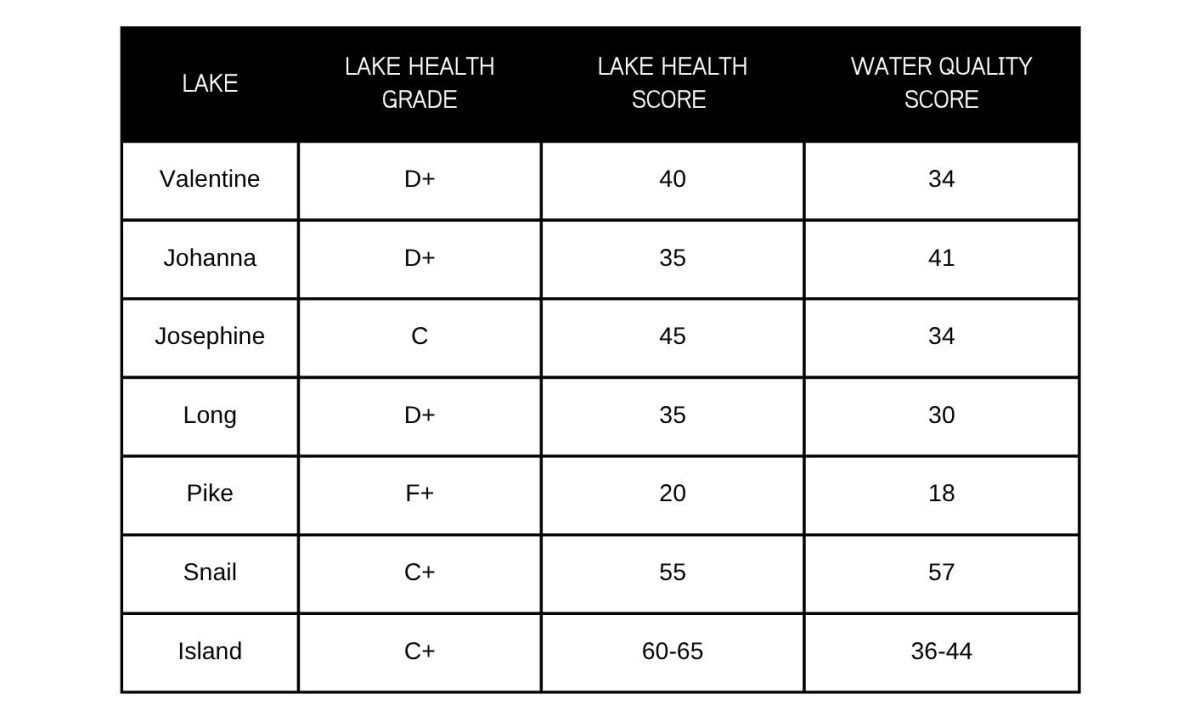
Valentine isn’t the only lake experiencing a general decline in water clarity and quality. Proximal industrialization and human presence all throughout the state have caused Minnesota lakes to undergo negative biological changes, with many Metro Area lakes given a health grade of C+ or lower, according to recent information from the MN DNR.
Creation Restoration’s hope for the future
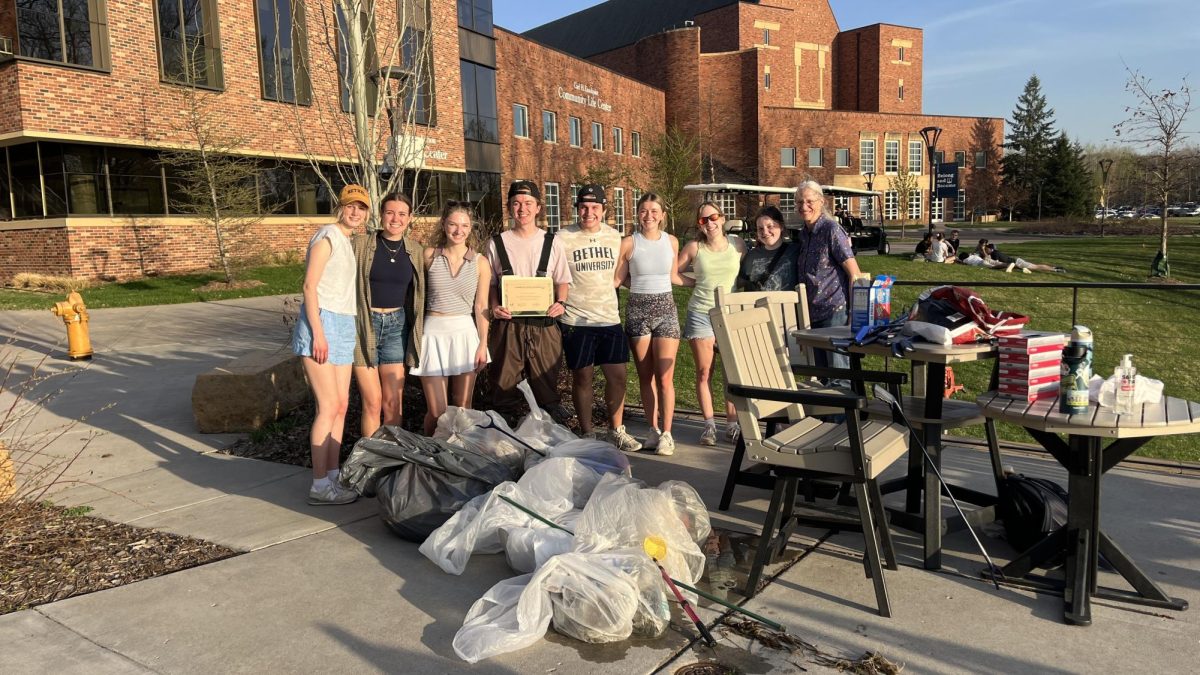
April 22, a small group of Bethel students gathered a few hours before sunset on the Lake Valentine patio. They listened intently as senior Jordan Smith read Saint Francis of Assisi’s The Canticle of Creation, kicking off an Earth Day campus clean-up event.
Smith and senior Anna Tikkanen, alongside sophomore Devin Stephens, lead Bethel’s Creation Restoration club. Under the provision of the biology department chair, Amy Dykstra, the club aims to show Bethel students the importance of caring for the environment.
“We really seek to have events that can help the broader student body connect with God’s creation and how they fit into that piece of seeing the glory of God through what He’s made for us,” Smith said.
After she finished reading the canticle, Smith and Tikkanen led student volunteers around campus to pick up trash from littering hotspots. One student even donned waders from the biology department and headed into the water, seeking to remove trash from the lake.
This kind of care and interaction with Valentine is exactly the sentiment Creation Restoration’s leaders hope to see grow among the student body.
“Lake Valentine is not just background scenery, it is a living system as well,” Stephens said. “Its beauty is reflected in how we treat the environment around us. I think if more students realized that, they may find a new sense of appreciation and responsibility to care for it in a God-honoring way.”
For more information on the health of lakes across the state, visit the Minnesota Department of Natural Resources website.