Last month, two private, nonprofit Massachusetts universities announced closures within nine days of each other – Hampshire College in Amherst April 14 and Anna Maria College in Paxton April 23.
In their announcements of closures, both universities cited declining enrollment and limited financial resources as key factors.
“We worked aggressively to increase enrollment, refinance existing debt, and realize new revenue via the sale of a portion of our land,” the announcement message from Hampshire’s president Jenn Chrisler and the Board of Trustees said. “We are faced with the clear, heartbreaking reality that progress on each of these three key factors has fallen far short of what we had hoped.”
The closures take place within a nationwide trend of declining enrollment in higher education across all levels, but particularly in private, nonprofit undergraduate programs.
An estimated 49 colleges across the country have closed or announced closures since 2020. Forty more have announced mergers with other institutions. The Anna Maria closure was not reflected in that number.
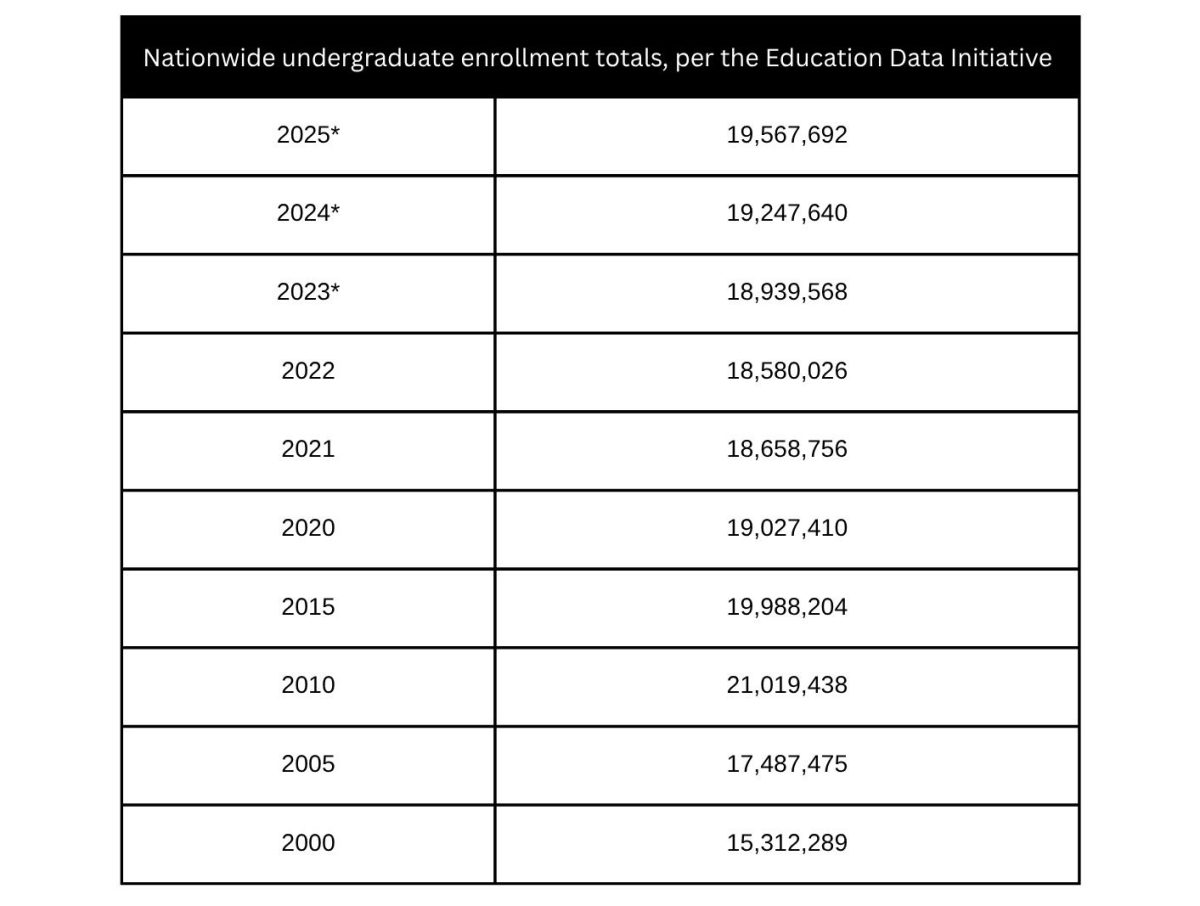
Undergraduate enrollment peaked in the United States in 2010, totaling 18.1 million students, and has declined ever since. 2024 enrollment is estimated at 16 million.
“Smaller schools are struggling to survive because there’s increasing cost pressures and demographic changes and enrollment changes,” Bethel University President Ross Allen said. “We’ve done some things to intentionally step into that and counter that.”
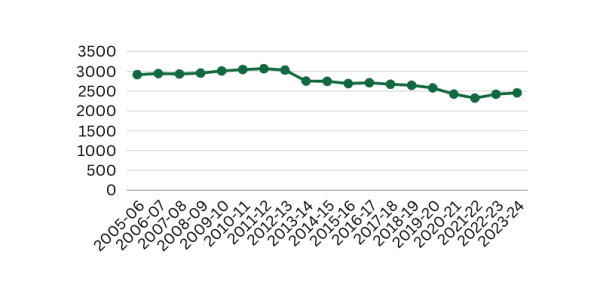
Bethel’s enrollment totals have reflected these numbers, as well. According to its latest enrollment data from the 2023-2024 school year, the College of Arts and Sciences enrollment saw a 19.2% decrease from its peak in 2010-2011 of 3,043 students.
Across all programs, Bethel tallied 4,357 students in the 2023-2024 school year. By contrast, Hampshire reported a fall 2023 enrollment of 716 degree-seeking students, while Anna Maria reported a grand total of 1,458 students, with 929 being undergraduate.
Best Colleges lists 90 universities and colleges that have closed or merged with other schools since 2020. Eleven of them enroll more than 2,000 students, while 29 enroll fewer than 500.
Declining enrollment across the nation + Bethel
The decline is projected to continue across the nation as a “demographic cliff” approaches. Following the 2007 Great Recession, the United States’ birth rate dropped; consequently, there are now fewer 18-year-olds graduating high school.
Research predicts that high school graduation and college enrollment numbers hit a slight peak in 2025 and will drop off significantly in the next decade and a half. From 2023 to 2041, the total number of high school graduates in Minnesota is projected to drop 13%. The nationwide drop is projected at 10%.
Fewer students overall means a smaller market for Paul McGinnis, Bethel’s Vice President of Marketing and Enrollment.
“It’s a market share game, in a way, because there’s only so many high school graduates, and they’re declining across the nation,” McGinnis said. “So we got to do things better than other schools.”
Bethel campaigns to get more enrollment
Bethel has tried to set itself apart from other schools through clearer tuition and a commitment to post-graduate opportunities for students. The school’s website says these campaigns are “uncommon in higher education—only a handful of schools nationwide offer both.”
In September 2024, Bethel announced that it was cutting tuition costs for all undergraduate students from $44,050 to $26,000. The new tuition costs went into effect for the 2025-26 school year.
The new price reflected what most students would already have paid after scholarships and aid, but was intended to “bring much-needed transparency to the cost of attending Bethel,” the announcement email to CAS students said.
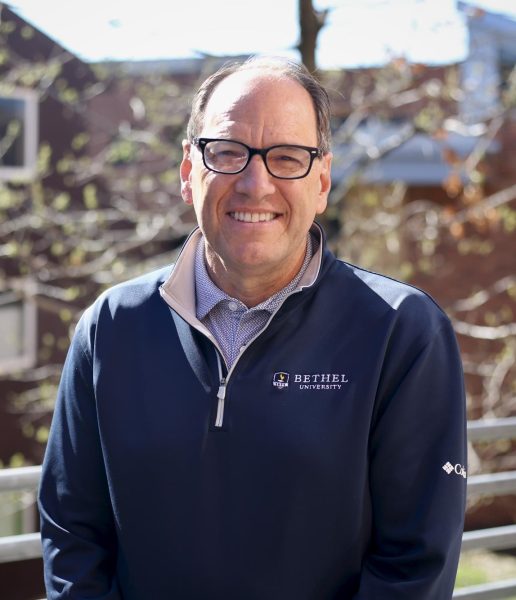
“I think the pricing change we made last year has, no question, made a significant impact. We got a lot of PR about that, and that always helps,” Allen said. “I’ve heard multiple families say, ‘We had concluded we couldn’t afford it, but now we see it’s a path.’”
One year later, Bethel introduced the Bethel Career Commitment. The campaign promises that if Bethel students haven’t secured a job or graduate school acceptance within six months of graduation, Bethel will provide “meaningful support” to help them reach their goals.
Eligible graduates may take up to eight graduate-level credits at Bethel at no cost or work a transitional job at the university.
Along with this commitment, Bethel launched the Studio for Vocation and Calling in 2025, which is intended to provide students with resources, networking, mentors and career coaching needed to secure post-graduate employment.
“We’ve addressed the number two issues that families have,” Allen said. “Can I afford it? And secondly, is it worth it?”
Allen said he believes these campaigns, along with Bethel’s emphasis on being a Christ-centered organization, have set the school apart.
From 2024-2025, the overall undergraduate enrollment for the 18 schools that make up the Minnesota Private College Council was 2.3%. In fall 2025, Bethel announced its overall increase was 7.6%.
Bethel welcomed 1,124 incoming students in fall 2025, its largest incoming undergraduate class ever. 547 of those students were enrolled through Minnesota’s Postsecondary Enrollment Option (PSEO), which has significantly boosted Bethel’s enrollment in the last decade.
“There’s a path you’ve got to go from kind of in crisis to survival to healthy to thriving,” Allen said. “We’re on that journey, and we’ve moved meaningfully up that journey.”
He also mentioned that Bethel is planning on having another year of a balanced budget.
According to ProPublica, the university’s net income for the fiscal year ending in May 2025 was $6,221,096. For the fiscal year ending in May 2024, the net income was $1,977,357. In 2023, it was -$689,780.
Program, faculty cuts
McGinnis said that “almost all” of the program and faculty cuts made over the past five years have been to address declining enrollment in the face of the demographic cliff.
“To cut a program, it’s the hardest thing ever, mainly because people are involved, right?” McGinnis said. “But at the same time, we’re stewards of the investment that we get from tuition and others.”
In spring 2020, Bethel cut 24 faculty positions, 13 majors and four minors.
In fall 2022, Provost Robin Rylaarsdam announced in an email to all CAS undergraduate students that 11 faculty positions were cut. Across the graduate school and adult undergraduate programs, eight additional faculty were either laid off or would not be replaced after retirement.
In fall 2025, Bethel’s journalism major and minor were discontinued.
“That’s what any organization does right, is looking at their products and services, whatever they do, and say, ‘What are the ones that are doing well, and what are the ones that aren’t?’” McGinnis said. “We have to have discipline to be able to do both.”
Additionally, after the 2026-2027 academic year, Bethel will no longer offer adult undergraduate bachelor’s degrees in psychology, business management or social work as part of a merger of its adult undergraduate, traditional undergraduate and graduate schools.
“The cuts are the ones that make the news, right?” McGinnis said. “But the investments have gone on.”
He emphasized that Bethel is investing in additional health care programs over the next few years.
“You have enrollment declines, and then you have the financial pressures, and then you have to do some cuts and resource layoffs because of that and then it affects morale,” Allen said. “People weren’t clear: Is Bethel committed to being a Christ-centered university? Whether that was true or not, that was a perception.”
Allen said that after the university addressed its financial situation, enrollment and tuition clarity, “morale is dramatically up.”
Ultimately, as America’s demographic cliff approaches, both leaders remain confident in Bethel maintaining positive enrollment numbers.