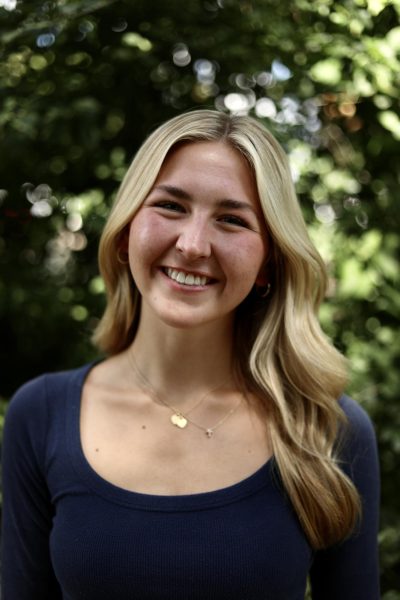









Bethel University freshman Michaela Bushnell stared blankly at her computer as she read the news about the rising tensions in Iran. Her mind went to her older brother, a deployed United States sergeant.
While these international conflicts in the headlines may seem far away to some Bethel students, many of these issues are affecting people in their backyard.
Bushnell has experienced the impacts of the Iran war that began after joint strikes on Feb. 28, 2026.
Despite being away from her brother, Bushnell and her family have been in contact with him. They talk to him over the phone for hours or play online board games together when he is given a pass to spend time by himself or talk to his family.
“My brother’s still safe. I can’t say anything more than that,” Bushnell said.
To some, political conflicts can seem scary and far away. Rather than remaining distant from the noise, Adjunct Associate Professor of History Amy Poppinga believes it is the duty of Christians to be politically literate.
“One of the greatest sins that is so easy to fall into as American Christians is, ‘I’m concerned with my life. My life is good enough. It doesn’t personally affect me. And thus I just don’t have time to know’,” Poppinga said.
She quoted Elie Wiesel, author and spokesperson for Holocaust remembrance, who said that “being indifferent is being immoral.”
However, Poppinga said there’s a contrast between ignorance and indifference. Lacking knowledge of something is not immoral; rather, being indifferent to those who are harmed is a greater issue.
“God calls us to wisdom, and God calls us to be aware,” Poppinga said. “Jesus speaks very clearly in the New Testament about the danger of being lukewarm.”
However, it is important to understand the history of global conflicts to grasp the bigger picture fully. In the case of the Middle East, historical and political literacy is key.
Poppinga explained that the U.S. and Iran have had a broken relationship since Iran’s revolution in 1979. This mistrust can extend even further back to the U.S. involvement in Iran’s government in the 1950s.
“The decisions being made today only make sense when you understand the decades of relationships, conflicts and alliances behind them,” she said. “What we’re seeing now is the latest chapter in a long history of mistrust, combined with current concerns about Iran’s nuclear program and its influence in the Middle East.”
Empathy and prayer are key as Christians come alongside neighbors and engage in educated conversations. While it may be difficult to fully understand what affected individuals are experiencing, people can grow in community through prayer and understanding.
“I think the best thing we can do to support our military right now is pray for them,” Bushnell said.
Poppinga said as Christians, being educated is “engaging in an act of care” for God’s creation.
“There is real power in recognizing that I don’t know what it’s like to be a parent not able to feel like my kids are going to have the rights of other kids. I don’t know what it’s like to be afraid that our neighborhood might be bombed tonight,” Poppinga said. “I don’t know what it’s like to live in a toppled government, but I actually do think I have the responsibility to think about it, to reflect upon it, to pray about it.”
It is important to try to understand the complexities of communities we are not culturally or religiously similar to.
“We tend to be dismissive of that which we don’t understand, and then we kind of condemn it without taking the time to understand it,” Poppinga said.
She urged Christians to extend compassion to all people.
“God does not just care about people who have the right theology,” Poppinga said. “God cares about people.”